


Step-by-Step Guide on Creating a Cryptocurrency Trading Bot in 15 Minutes
Cryptocurrency trading bots are algorithm-based programs capable of executing trades on exchanges independently, responding to market fluctuations around the clock. Want to learn how to create and configure your own trading bot? This article is your detailed guide!
In this article, we will:
- Understand what cryptocurrency trading bots are and what advantages they offer.
- Choose a suitable exchange and look at what types of trading bots they offer and how they differ.
- Create and configure a simple trading bot using a step-by-step guide.
- Optimize the bot’s strategy to achieve maximum efficiency.
- Analyze the bot’s performance results and make the necessary adjustments.
How trading bots work
For example, the simplest bot strategy — a grid of orders — works like this:
- Action:
- Buy Litecoin every $5 below the current price.
- Sell Litecoin every $5 above the current price.
- Result:
- Automatic buying when the price falls.
- Automatic selling when the price rises.
- Saving the trader time and effort.
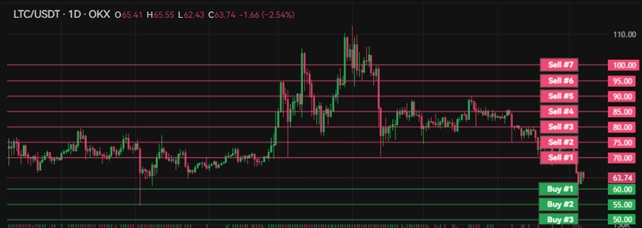
Slightly more advanced DCA bots buy coins based on a fixed amount and time intervals in order to average the purchase price. More advanced bots take dozens of factors into account, such as indicators, market data, and exchange rates.
Below, we will look at different types of bots that can be created without programming on popular exchanges.
Advantages of using trading bots
Depending on the chosen strategy and market conditions, trading bots can often provide a stable stream of profit, minimize risks, and automatically execute trading operations, freeing you from the need to constantly monitor positions.
Here are the main advantages of automation over manual trading:
- 24/7 operation: bots can work around the clock without missing profitable opportunities, even when you are asleep or away from your computer.
- Emotional discipline: bots are free from emotions, allowing them to follow a trading strategy without being influenced by fear, greed, or other human factors.
- High speed: bots can react instantly to market changes, executing trades at high speed.
- Diversification: bots can be used to trade across several markets at the same time and with different strategies, allowing risks to be diversified.
- Improved efficiency: bots can help increase the effectiveness of your trading by optimizing strategies and reducing risks.
Important:
- Trading bots do not guarantee profit. Like any tool, their use involves risks.
- Before using a trading bot, it is necessary to carefully study how it works and configure its settings.
- You should not blindly trust a bot.
- It is important to monitor its operation and adjust the strategy when necessary.
Risks of using cryptocurrency trading bots
Despite the many advantages, the use of cryptocurrency trading bots involves a number of risks that must be taken into account:
1. Technical risks:
- Software errors: bots, like any software, may contain bugs that can lead to unexpected and unprofitable trades.
- Exchange outages: technical issues on the exchange may prevent the bot from executing trades, which can lead to missed profits or losses.
2. Financial risks:
- Changes in market conditions: the cryptocurrency market is highly volatile, which means prices can change sharply.
- Ineffective strategy: if the strategy on which the bot operates is ineffective, it can lead to losses.
- Non-optimal settings: incorrect bot settings can result in unprofitable trades.
3. Risks when using third-party bots:
- Use of dishonest bots: there are dishonest bot developers who may create bots that do not actually work or are even intended to deceive users.
- Loss of control over funds: when using some bots, you may need to give them access to your funds on the exchange, which carries the risk of theft.
Important:
- Before using a trading bot, carefully study how it works and the reviews of other users.
- Do not invest more in bots than you can afford to lose.
- Do not hand over control of your funds to unverified bots.
- Constantly monitor the bot’s operation and adjust its strategy when necessary.
Remember: using trading bots is not a passive way to earn money. To succeed, you will need knowledge of the cryptocurrency market, an understanding of how bots work, and constant control over their activity.
We recommend using only built-in bots on well-known exchanges — this minimizes the risk of losing funds due to technical errors or hacking.
Popular cryptocurrency exchanges where you can create a bot
Many major exchanges allow you to create trading bots without programming. We will talk about the strategies they offer, customization options, and additional features such as AI and copy trading.
 Bybit
You can choose from various types of pre-configured, no-code trading bots that implement effective trading strategies, saving your time and potentially increasing profits.
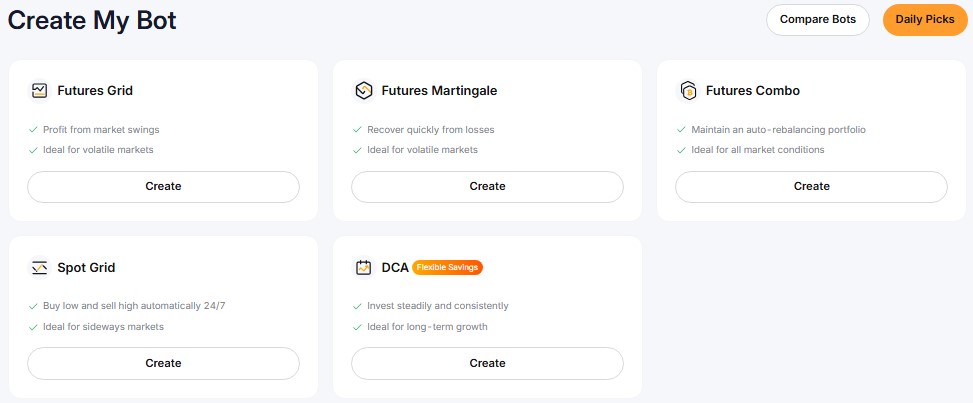
Bybit offers 4 types of trading bots: Futures Grid Bot, Futures Martingale, Spot Grid Bot, and DCA. We will explain each type of trading bot in more detail below.
Bybit has its own built-in artificial intelligence for automatically creating trading bots in one click — AI Aurora. It creates and recommends 18 strategy sets using trading bots. AI Aurora is based on an analysis of four days of historical market data, which makes it possible to determine optimal strategy parameters, including profitability, arbitrage frequency, and other factors. These indicators are used to create bot strategies with intelligent parameters, including the futures grid bot, futures Martingale, and spot grid bot.
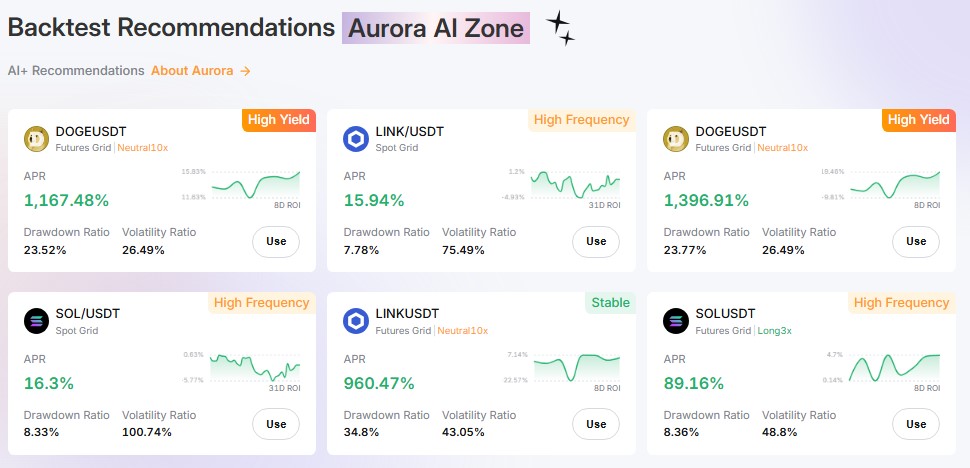
Based on historical data, the best strategies are divided into several categories: High Profit, Stability (strategies with the lowest drawdown), and High Trading Frequency (strategies with the highest trading frequency).
The claimed successful trade rate is over 70%.
No additional fees are charged for using the Bybit trading bot, including when using AI Aurora.
There is also an option to copy active trading bots from experienced traders, although you will need to share part of the profit earned by the bot.
 OKX
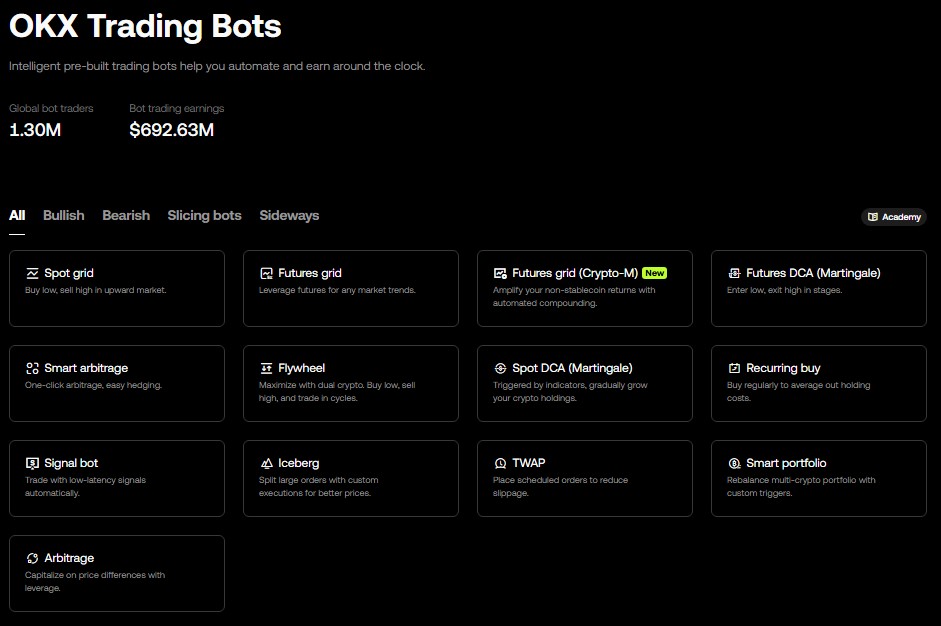
OKX trading bots are also absolutely free for all users. The selection of trading bot types on OKX is somewhat broader. Here you can create:
- Spot Grid Bot
- Futures Grid Bot
- Futures DCA
- Spot DCA
- Infinity Grid
- Recurring Buy
- Smart Portfolio
- Dip Sniper
- Peak Sniper
OKX has a bot marketplace — a place where traders can share their spot grid, futures grid, DCA, smart portfolio, and recurring buy bots. Regular users can easily copy the parameters of successful strategies. To copy, you need to share a percentage of net profit with the strategy creator — from 0 to 30%. This parameter can be seen in the card before copying the bot.
When creating a trading bot, several strategies with settings based on Artificial Intelligence analysis are offered.
 HTX
HTX offers beginners two ways to start trading with grid bots:
• Auto: Thoughtful recommendation
The system will set the most suitable parameters based on historical data analysis, while users only need to set the investment amount.
• Strategy Duplicator
You can easily find the top winners in the Grid Trading ranking and copy their trading strategy with just a few clicks to manage your trading. You can also set your own parameters if you are just starting to get used to grid trading.
Trading bot strategies
Grid Bot
- Works by placing buy orders below the reference price of a crypto asset and sell orders above the reference price.
- These buy and sell orders are placed at equal distances from one another, called “grids,” and can be set within a strict price range.
- Grid bots are designed to take advantage of price volatility, that is, sideways price movement in crypto assets.
- As the price rises, a sell order is triggered, and a new buy order is placed below the asset price, essentially “replacing” the last executed sell order.
- Similarly, when the price falls, a buy order is triggered, and a new sell order is placed above the asset price to “replace” the last executed buy order.
- The difference between the buy and sell orders, that is, the grid spacing, is the profit.
On OKX, there is a variation of the grid bot — Infinity Grid. In essence, it is the same grid bot, but limited only by the lower price boundary, the investment amount, and the percentage profit per grid that you choose.
Futures Grid Bots
Futures Grid Bots are the same as regular Grid Bots, but they are used in the futures market.
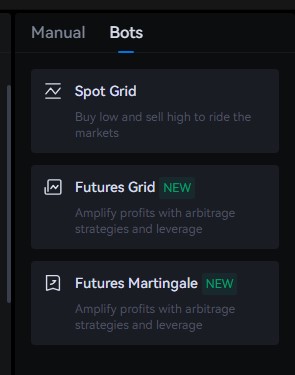
Main differences:
1. Futures Grid Bots: trade cryptocurrency futures contracts.
2. Futures Grid Bots: can use leverage, which allows for increased trading volume and potential profit, but also increases risks.
3. Futures trading fees are usually lower than on the spot market.
4. Regular Grid Bots: risks are limited to the potential fall in cryptocurrency prices. Futures Grid Bots: risks include not only the potential fall in cryptocurrency prices, but also risks associated with leverage, such as a margin call or forced liquidation of the position.
In general, futures Grid bots offer higher profit potential than regular Grid bots, but are also associated with higher risks.
The choice of Grid bot type depends on your trading strategy, risk appetite, and experience.
DCA Bot (Dollar-Cost Averaging Bot)
- Involves purchasing a fixed amount of a specific cryptocurrency at regular intervals rather than making one large purchase.
- Using DCA bots gives you flexibility in setting the frequency and amount of your trades.
- This means you can choose how often you want to make purchases, allowing you to select the frequency and amount that match your investment strategy and risk tolerance.
Martingale Bot
- Based on the traditional Martingale strategy, it automatically places an additional order when the market price experiences a certain percentage increase or decrease, attempting to recover all losses and ultimately make a profit when the market moves in your favor.
- However, given its unpredictable nature, it can lead to larger losses if your account runs out of funds before the bot is able to recover losses, or if the bot’s settings are not suitable for current market movements.
Smart Portfolio – a bot for automated portfolio rebalancing
How it works:
- Choose assets: determine which assets you want to include in your portfolio.
- Set proportions: define the desired percentage allocation among the selected assets.
Configure the rebalancing mode:
- Time-based rebalancing: choose how often rebalancing should occur, for example weekly or monthly.
- Threshold-based rebalancing: set a threshold percentage, for example 1%, at which rebalancing will be triggered.
How rebalancing works:
- The system tracks changes: the bot continuously monitors the value ratio of the assets in your portfolio.
- Rebalancing is triggered:
- By time: when the specified rebalancing period arrives.
- By change: when the difference in asset values exceeds the set threshold, for example 1%.
- Adjustment takes place:
- Selling: part of the asset that has increased in value is sold.
- Buying: the proceeds are used to buy the asset that has fallen in price.
- Maintaining proportions: as a result of rebalancing, the original percentage allocation of assets in your portfolio is restored.
Advantages of automated rebalancing:
- Time saving: automates the rebalancing process, eliminating the need to manually track and adjust your portfolio.
- Discipline: ensures a disciplined approach to rebalancing, helping you stick to your chosen strategy.
- Risk reduction: helps maintain optimal diversification, reducing the risks associated with overweighting a single asset.
Example:
- You choose percentage-based rebalancing mode and set it to 1%.
- Your portfolio contains two assets: Asset A (50%) and Asset B (50%).
- The price of Asset A rises by 10%, while the price of Asset B falls by 5%.
- Rebalancing takes place:
- Part of Asset A is sold.
- The proceeds are used to buy Asset B.
- As a result of rebalancing, the asset allocation in your portfolio returns to 50/50.
Trading bots: “Dip Sniper” and “Peak Sniper”
Dip Sniper
Description:
This bot allows you to buy cryptocurrency at a lower price than it is currently trading at by using a “buy the dip” strategy.
“Dip Sniper” is a zero-fee cryptocurrency purchase strategy at a price below the market price. It guarantees the purchase of at least some amount of cryptocurrency at the desired price on the specified date without worrying about missing out.
How it works:
- Determine the current price:
- The bot displays the current cryptocurrency price, for example BTC = $30,651.
- Set the desired purchase price:
- Determine the price at which you want to buy the cryptocurrency, for example BTC = $26,080.
- Choose the quantity:
- Specify how much cryptocurrency you want to buy at that price, for example 1 BTC.
- Choose the contract term:
- The longer the term, the more cryptocurrency you will be able to buy at the set price; the maximum term allows you to buy 12.35% of 1 BTC.
- Guarantees:
- At the end of the term, the exchange is guaranteed to sell you 12.35% of 1 BTC, even if the price rises.
- If the price reaches your desired purchase price, you will be able to buy 100% of the BTC.
Limitations:
- To use the bot, you need to lock up your funds for the specified contract term.
- The shorter the term, the smaller the percentage of cryptocurrency you will be able to buy at the desired price.
Peak Sniper
This bot works similarly to “Dip Sniper,” but in the opposite direction. It allows you to sell cryptocurrency at a higher price than it is currently trading at by using a “catch the peak” strategy.
Creating a trading bot
Above, we have already looked at crypto exchanges where you can create trading bots and the various types of existing bots. Next comes a step-by-step guide to creating a simple bot using the example of the Bybit crypto exchange.
Step-by-step guide to creating a bot on Bybit
1. Choose the cryptocurrency pair the bot will work with, for example BTC/USDT.
2. Price range:
- Determine the minimum and maximum prices within which the bot will operate.
- The wider the range, the greater the potential profit, but the higher the risks as well.
3. Number of grids:
- The number of grids determines the distance between buy and sell orders. The smaller the step, the more orders will be created, the lower the price volatility needed for orders to trigger, but the lower the potential profit as well. Make sure the profit per grid is higher than the exchange trading fee. In my experience, the optimal price step is from 0.5% to 2%, depending on the volatility of the chosen currency.
4. Investment:
- the amount of cryptocurrency the bot will use for trading.
Optional parameters:
5. Entry price: the price at which the bot will start trading once reached. If left blank, the bot will start working immediately upon creation at the current price.
6. Take profit: set a profit level at which the bot will automatically close part of the orders, locking in profit.
7. Stop loss: set a loss level at which the bot will automatically close all orders, limiting losses.
Bots, like any other trading tools, are not risk-free. To minimize risks and increase your chances of success, you need to:
1. Set a stop loss:
- Be sure to set a stop loss for each order.
- This will allow you to limit potential losses if the cryptocurrency price drops sharply.
2. Diversification:
- Do not invest all your funds in one Grid bot.
- Spread your investments across several bots and cryptocurrency pairs.
- This will help reduce risks and increase the overall resilience of your portfolio.
3. Careful parameter selection:
- Do not rush when configuring the bot.
- Carefully analyze the market, choose a suitable trading pair, price range, grid step, and other parameters.
- Make sure you understand how the bot works and what risks it carries.
4. Psychological preparation:
- Remember that trading in the cryptocurrency market always involves risks.
- Do not give in to азарт and do not risk more than you can afford to lose.
- Stay calm and use common sense — stick to your chosen strategy in advance, not to emotions.
Conclusion
Advantages of bots:
- Automation — they free up your time and allow you to trade around the clock.
- Discipline — they follow the parameters you set and are not influenced by emotions.
- Potential profit — they can generate profit with any price movement within the specified range.
Disadvantages of bots:
- Risks — they do not guarantee profit and can lead to losses during sharp market movements.
- Complexity — configuring and using some bots may be difficult for beginners.
- Limitations — they are mainly effective in volatile markets and require careful parameter selection.
Tips for beginner traders:
- Learn the basics of trading — before using bots, make sure you understand how they work and the risks involved.
- Start with a demo account or a minimal amount: test the bot before risking real money.
- Manage risks: do not invest all your funds in one bot; use stop losses and other tools.
- Diversify: do not trade only one cryptocurrency, and use several bots with different settings.
- Remember: trading in the cryptocurrency market always involves risks. Invest only the funds you can afford to lose.
Additional resources:
- Bybit Learn — free educational materials from the Bybit crypto exchange.
- Guide to creating a bot through programming: https://habr.com/ru/companies/ruvds/articles/517234/
Glossary of terms related to cryptocurrency trading and trading bots
General terms:
- Cryptocurrency exchange — a platform where cryptocurrencies can be bought, sold, and exchanged.
- Cryptocurrency — a digital asset that uses cryptography to secure transactions and control the creation of new units.
- Blockchain — a distributed database that records cryptocurrency transactions.
- Trader — a person or program that buys and sells cryptocurrencies.
- Volatility — the degree of change in the price of a cryptocurrency over a short period of time.
- Risk — the probability of losing money when trading cryptocurrency.
- Profit — the positive difference between the purchase and sale price of a cryptocurrency.
- Loss — the negative difference between the purchase and sale price of a cryptocurrency.
- Technical analysis — the study of historical price and trading volume data in order to forecast future market movements.
- Fundamental analysis — the evaluation of a cryptocurrency’s value based on its underlying characteristics, such as technology, team, and use potential.
Trading terms:
- Order — an instruction to buy or sell cryptocurrency at a specific price.
- Market order — an order to buy or sell cryptocurrency at the best available price.
- Limit order — an order to buy or sell cryptocurrency at a specific price or better.
- Stop loss — an order to sell cryptocurrency that is automatically executed when the price reaches a certain level, limiting losses.
- Take profit — an order to sell cryptocurrency that is automatically executed when the price reaches a certain level, locking in profit.
- Margin trading — trading using borrowed funds from the exchange, which allows you to increase potential profit but also increases risks.
- Leverage — the ratio between your own funds and borrowed funds used in margin trading.
- Liquidation — the forced sale of your cryptocurrency by the exchange if your margin account balance falls below a certain level.
Terms related to trading bots:
- Trading bot — a program that automatically executes trades on a cryptocurrency exchange.
- Signal bot — a bot that analyzes market data and generates signals to buy or sell cryptocurrency.
- Automated bot — a bot that independently executes trades based on algorithms you set.
- Grid strategy — the placement of buy and sell orders at equal intervals within a specified price range.
- DCA (Dollar-Cost Averaging) — a dollar-cost averaging strategy that consists of regularly buying cryptocurrency for a fixed amount regardless of price.
- Futures — contracts for the purchase or sale of cryptocurrency at a specified price in the future.
Share your experience using trading bots in the comments.
DISCLAIMER
THIS ARTICLE IS PROVIDED FOR INFORMATIONAL PURPOSES ONLY. IT DOES NOT CONSTITUTE ANY FORM OF INVESTMENT, TAX, OR LEGAL ADVICE AND SHOULD NOT BE CONSIDERED AN OFFER TO BUY, SELL, OR HOLD DIGITAL ASSETS. DIGITAL ASSETS, INCLUDING STABLECOINS, INVOLVE HIGH RISKS AND ARE SUBJECT TO STRONG FLUCTUATIONS, INCLUDING THE POSSIBILITY OF TOTAL LOSS OF VALUE. YOU SHOULD CAREFULLY CONSIDER WHETHER TRADING OR HOLDING DIGITAL ASSETS IS SUITABLE FOR YOU IN LIGHT OF YOUR FINANCIAL SITUATION. FOR DETAILED ADVICE, PLEASE CONSULT A LEGAL, TAX, OR INVESTMENT PROFESSIONAL.